CUSMA could raise the cost of free trade for Canada
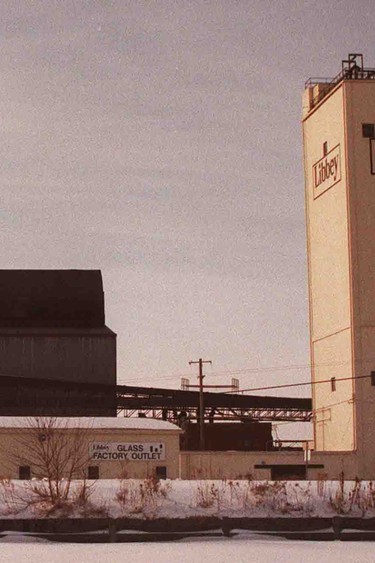
U.S. demands for concessions on CUSMA are stirring up painful memories in communities like Wallaceburg, Ont., where some wonder if the price Canada already paid for free trade is being exacted anew
Article content
Traffic jams. That’s one of the first things that John Gardiner thinks about when he recalls what Wallaceburg, Ont., was like in the 1980s.
“When I first moved to Wallaceburg in 1985, there were roughly 9,000 manufacturing jobs in a town of 11,000 people,” said Gardiner, an author who worked for decades as a journalist and publisher in the once-thriving community across Lake St. Clair from Detroit. “The town rocked 24 hours a day because of the shift work.”
Article content
Article content
Advertisement 2

Article content
That started to change in 1999, when Libbey Canada Glass Co., a century-old manufacturer that had earned Wallaceburg the moniker Glasstown, closed its doors after its Ohio-based parent company abruptly announced it would shift production to other factories in the United States and Mexico.

FP West: Energy Insider
Article content
The move threw about 500 people out of work. Some of the newly unemployed Canadians had been at Libbey for more than 30 years, starting in their teens without finishing high school. Others were second- and third-generation employees.
The Libbey Glass closure, which came a decade after the implementation of the initial Canada-U.S. Free Trade Agreement in 1989, was the most notable among a slew of factories and plants that would disappear from the town. A list of 18 closures compiled by the Wallaceburg District Museum put published job losses at around 1,500, but locals like Gardiner peg the number even higher.
“In its day, Wallaceburg was the manufacturing hub of Southwestern Ontario. All of that is pretty much gone now,” he said. “The town is much quieter.”
Article content
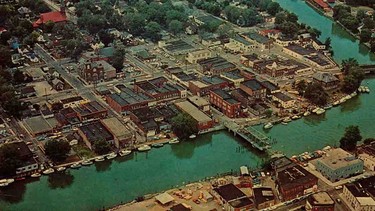
Free trade with the U.S. is almost universally viewed by economists today as having been a win for the Canadian economy. But the broader gains came with costs for Wallaceburg and others towns like it across the country, particularly those built around manufacturing.
Article content
“It was good for the economy overall, but … there were losers, and they were longtime losers,” said Dan Ciuriak, an international trade economist and consultant.
“For many people, there was a lifetime cost.”
For many people, there was a lifetime cost
Dan Ciuriak, an international trade economist and consultant
Now, with a July 1 review of the trilateral Canada-U.S.-Mexico Agreement (CUSMA) set to launch and the current U.S. administration pressing to revamp the terms of trade — including threatening to claw back jobs from Canada in industries such as autos and aluminum — there is a sense that the price Canadians already paid for access to the U.S. market is being exacted again.
“All the things that we put in place to participate in the global factory are now being undermined,” Ciuriak said. “The pain that we bore to join that world is going to be compounded by a new pain from undoing it.”
‘Leap of faith’
When the U.S.-Canada free trade deal was first struck, even its proponents acknowledged it was a “leap of faith” — a term adopted by former Liberal cabinet minister Donald MacDonald, who led a pivotal 1985 royal commission report that recommended Canada pursue free trade with its much larger southern neighbour.
“Canada would gain several advantages by negotiating a free-trade agreement with the United States,” the commissioners wrote, noting that Canada was already reliant on its most important trading partner. “It is imperative that Canada reduce both the uncertainty of our access to U.S. markets and the adverse effects that might result from any trade-restrictive measures.”
Article content
Economic theory dating back to Adam Smith in the 18th century has laid out the case for free trade, with Smith reasoning that trade between countries benefits all when each focuses on goods it can produce most cheaply. Later economists advanced the concept of comparative advantage: even if a country is less efficient at producing all goods than its trading partner, it will still benefit by producing the things it can make most efficiently and trading them. Free trade proponents point out that it expands the size of the available market, with the resulting economies of scale bringing down costs, while added competition forces producers to become more efficient, driving economic growth.

“Free trade allows Canadian producers to sell at higher prices and allows Canadian consumers to buy at lower prices. It’s as simple as that,” said Daniel Trefler, chair in Competitiveness and Prosperity at the Rotman School of Management.
But free trade also requires faith in the market mechanism, with specific jobs and economic activity migrating to the jurisdictions where they can be done more efficiently overall, imposing costs on both sides as well.
The benefits of free trade to Canada are clear in the numbers.
Article content
Canada’s merchandise exports to the U.S. had grown more than fivefold to $547.4 billion by 2024 from $101.6 billion in 1989, according to data from Global Affairs Canada. By the early 2000s, the U.S. accounted for 87 per cent of Canada’s global merchandise exports, up from 60 per cent in the early 1980s.
That is equivalent to Canada receiving — for free — a bond that pays $20 billion a year
Daniel Trefler, Rotman School of Management
Canada’s manufacturing productivity also rose. Trefler’s calculations show that the Canada-U.S. free trade agreement boosted total Canadian manufacturing productivity by 13.8 per cent as exporters increased their sales to the U.S. and expanded their revenue bases. This spurred innovation and the adoption of advanced manufacturing technologies, he said.
“That is equivalent to Canada receiving — for free — a bond that pays $20 billion a year,” Trefler said. “The idea that a single simple policy, tariff reductions, could have such a big impact on the economy is extraordinary.”
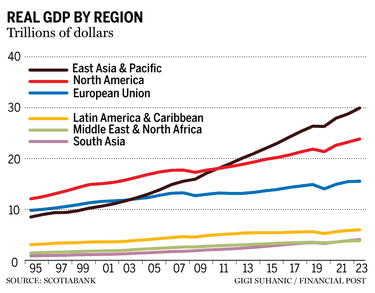
Since 1995, when Mexico was included as a third partner in the North American Free Trade Agreement (NAFTA), North America has experienced greater economic growth than any other region globally except East Asia, according to a report published by Bank of Nova Scotia economists last year.
But the costs, at least in the earlier years, were equally apparent.
Article content
The Free Trade Agreement reduced total manufacturing employment by five per cent, or 100,000 jobs, according to a 2004 paper Trefler wrote, published in the American Economic Review. Most of these lost jobs were concentrated in import-competing industries exposed to deep tariff concessions, with one in eight jobs disappearing.
“This number points to the very large transition costs of moving out of low-end, heavily protected industries,” he wrote. “It reflects the most obvious of the costs associated with trade liberalization.”
Canada’s unemployment rate rose to 11.4 per in 1993 from 7.5 per cent in 1989, a figure Ciuriak says was even worse than it appeared considering the decline in employment participation in the later period.
In Huntingdon, Que., a town of around 2,600 people about an hour’s drive southwest of Montreal, the textile sector once thrived. But a series of shutdowns after the Free Trade Agreement came into effect threw hundreds out of work. Cleyn & Tinker, a Canadian wool manufacturer, shut down five plants in Quebec in the spring of 2004, shifting operations to Burlington, N.C.
There was definitely a shock, a cost in the short run, but people adjusted to that cost in a way that wasn’t detectable 16 years down the road
Peter Morrow, University of Toronto
In December of that year, another shutdown — Huntingdon Mills Canada Ltd., a sports textile maker — shook the town. The mayor estimated the local economy would lose $25 million as a result of the closures, which were blamed in part on a low Canadian dollar relative to the U.S. currency and on increasing competition from China.
Article content
Ottawa tried to help, putting together a multi-million rescue package that included funds relief on the cost of raw materials for the Canadian textile manufacturers and incentives to encourage them to shift into higher value products and markets where they would face less competition.
That aid package was one in a series of government supports put in place at the time of the Free Trade Agreement and its aftermath.
Despite the fallout for certain towns and industries, Canadians ultimately adjusted to the upheaval, according to Peter Morrow, a professor of economics at the University of Toronto.
Article content

“There was definitely a shock, a cost in the short run, but people adjusted to that cost in a way that wasn’t detectable 16 years down the road,” said Morrow.
That cost already incurred, and in many cases long forgotten, is what makes the current U.S. demands even more irksome for some observers, including Derek Burney, who was prime minister Brian Mulroney’s chief of staff during the Free Trade Agreement negotiations and was at the bargaining table in 1988. In his view, Canada is being pressured to pony up just to maintain the trade pact the two countries forged long ago.
“The notion that we have to pay an entry fee to get into a negotiation in order to extend the agreement, that’s absurd,” he said.
Article content
Burney said Ottawa’s declaration in June that it will order to the Canadian Radio-television and Telecommunications Commission to review a decision tripling the funds U.S. streaming services such as Netflix must earmark for Canadian content — an irritant for the Trump administration — is a concession made with nothing in return.
The list of potential demands the current U.S. administration has floated is long and includes targeting Canada’s previously untouchable supply management system, put in place in the 1960s and 1970s to coordinate production and demand for dairy and other agricultural products while controlling imports, with the intention of setting stable prices for farmers and consumers.
We are learning, painfully, that a relationship built on the ‘chemistry’ of leaders is unsustainable
Richard Leblanc, York University
Richard Leblanc, professor of governance, law and ethics at York University, warned in a June 23 article that this trajectory could even lead the U.S. to come after investment access to Canadian water, energy, telecommunications and critical minerals, while requiring the removal of environmental restrictions such as plastic bans on U.S. products.
“We are learning, painfully, that a relationship built on the ‘chemistry’ of leaders is unsustainable when the larger partner decides to unilaterally rewrite the terms of engagement,” he said.
Article content
The townsfolk in Sainte-Croix, Que., about a three-hour drive northeast of Huntingdon on the other side of Montreal, are already getting a taste of what could come from the seismic shift in U.S. trade policy. In April, South Shore Furniture shut down its operations there and in nearby Coaticook, Que., letting around 125 employees go. The family company established in 1940 blamed a 77 per cent sales plunge on U.S. tariffs and “massive dumping” of imported products, which caused prices to collapse and made local production unsustainable.
Wallaceburg residents who were paying attention would likely feel a pang of recognition when a second furniture maker in the region, Bestar Inc., announced its closure the same week.
Unifor, Canada’s largest private sector union, said U.S. trade measures were redirecting global flows and turning Canada into a “fallback market” for low-cost imports, with wider implications for the supply chain since both manufacturers had used locally sourced wood.
Article content
”When companies shut down one after another, it’s not a coincidence,” Daniel Cloutier, a Unifor director in Quebec, said in a statement. “It’s the result of an extremely challenging economic environment where businesses are facing deteriorating market access conditions (in the U.S.), compounded by growing dumping practices, particularly from Asia.”
Article content
Many of the factors that were at play when Mulroney controversially initiated free trade talks with the United States in the 1980s sound familiar today. A more protectionist U.S. administration was stepping up its use of trade remedies. Canada was looking at regulatory and tax reforms to increase economic efficiency and was open to more foreign investment.
At the time, there was a good rationale for the trade pact, but as Ciuriak pointed out, Canada moved ahead with the idea that the costs would be borne early — and once — and then the long-term payoffs would come.
“In other words, the policy objective was to put the Canadian economy on a faster growth trajectory, which would generate sustained longer-term gains that would cumulatively outweigh any short-run adjustment costs,” he said.
Mulroney’s election victory in 1988 allowed him to push aside the concerns of Liberal leader John Turner, head of the official opposition in Ottawa, and some provincial premiers, who feared that Canada would be giving up control of key “economic levers” to a much larger partner.

A few years after Wallaceburg lost the glassware plant that gave the town its nickname, Oxford Automotive Inc. closed up shop, too. The facility, which had employed more than 600 people in town in its heyday, announced the closure in late in 2003. The following year, the town said goodbye to North American Plastics, whose abandoned building sat mostly empty as a reminder of what was lost for about 20 years before being demolished in 2014, according to local media reports. Brass forger and bathroom fixture manufacturer Waltec, which once had four thriving plants in Wallaceburg, is also gone, as the trail of closures continued to grow while the population fell.
Article content
Gardiner said the manufacturing jobs paid well and there were feelings of abandonment as they disappeared.
“Nobody paid any attention while the town was gutted,” he said.
Even a success story like the three-generations-run St. Clair Tool & Die, which employed more than 500 people in Wallaceburg before free trade, retained only a head office rebranded as St. Clair Technologies and fewer than 20 employees by 2016. Most of the office and manufacturing jobs had shifted to Arizona and Sonora, Mexico.
Nobody paid any attention while the town was gutted
John Gardiner, Wallaceburg resident
Burney says tradeoffs were always kept in mind during the negotiations of the Free Trade Agreement, but the mutual benefits for Canada and the United States were front and centre at all times during sometimes tense negotiations. That’s something he doesn’t see today.
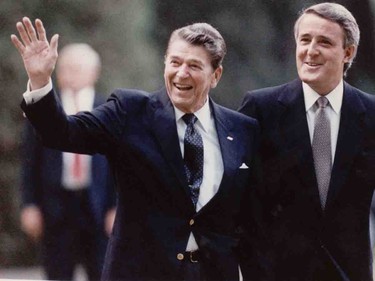
“Both (U.S. president) Ronald Reagan and Brian Mulroney were very supportive of the concept of free trade and the mutual benefit that they thought that that would bring,” he said in an interview from his cattle ranch in Golden, Col., which he operates with his son. “That’s the fundamental difference between then and now. The two leaders today do not have a common purpose about the objective, and the concept of mutual benefit is not part of Donald Trump‘s lexicon.”
Article content
He is incredulous that the Trump administration is trying to force changes to established trade policy such as rules of origin for autos to favour production in the U.S., something Burney says could penalize Canada beyond the initial impact by interfering with its trade commitments to the European Union and the Trans-Pacific Partnership.
“Mutual benefit is the central part of any trade agreement. Both sides have to come away as winners, otherwise there’s no point,” he said. “Trump has no interest in that aspect of a trade agreement, for him it’s my way or no way. And I think we have to be just as firm in rejecting what they’re proposing.”
Article content

He said the negotiations in the 1980s were contentious at times, and there was a lot of opposition, including from politicians in provinces such as Ontario and from trade groups. But the Canadian bargaining team did not enter the agreement lightly, even walking away late in the negotiations and putting the agreement at risk when the U.S. balked at a key requirement to ensure Canada was not subsumed by its much larger partner.
“We were concerned about the power imbalance — what we’re experiencing in spades today — and that was that they are 10 times our size,” he said. “They are 10 times as powerful, and how risky would it be to enter into an agreement with a country like that?”
Article content
At first, the American team including U.S. treasury secretary James Baker, balked at Canada’s insistence on a binding dispute mechanism, Burney recalled. But the Canadian team was convinced that no deal was better than a bad deal. When the U.S. team returned to offer another round of negotiations to deal only with tariffs, where Canada was at a disadvantage before free trade, Burney said the Canadian team turned it down, holding out for the dispute resolution protection they believed they needed.
“That was to protect us in the event that the Americans decided to use their power to override basic rights, which, you know, is exactly what Trump is doing,” he said.
It’s astonishing me the extent to which Donald Trump has taken the Republican Party away from its traditional pro-free-trade position
Derek Burney
Burney recalls that Mulroney threatened to go directly to Reagan, sure that the U.S. president felt strongly enough about getting the free trade agreement that he would intervene directly. That was enough, he said, for the treasury secretary to get down to brass tacks and discuss how the binding dispute mechanism could work.
Eventually the American team came around, he said, adding that the binding trade dispute settlement mechanism in the Free Trade Agreement became the model for a similar tool put in place at the World Trade Organization.
Article content
Burney said his experience in the 1980s stands in stark contrast to the present day, when a large number of U.S. Republicans are opposing free trade, an economic tool their party once embraced.
“It’s astonishing me the extent to which Donald Trump has taken the Republican Party away from its traditional pro-free-trade position,” he said. “You’re beginning to see a few cracks now, and I hope more will come as the situation continues to deteriorate. But the Republicans were staunch supporters of free trade, the Democrats were the problem.”

Carlo Dade, director of the centre for international policy and the New North America Initiative at the University of Calgary’s school of public policy, said Trump’s attempts to exert executive branch powers and to use trade and tariffs in pursuit of U.S. interests marks a “paradigm shift” that goes beyond political parties.
He noted that Trump’s son-in-law, Jared Kushner, set the stage in 2020 by describing CUSMA as a short-duration lease for market access, with a readjustment clause triggered every six years that would give leverage to the stronger party in the event of disagreement. The U.S., Kushner wrote, would probably always win, given the relative size of its economies.
Article content
Dade said it is clear the U.S. now feels like the landlord, putting Canada and Mexico in the position of lessors forced to renegotiate a growing list of terms in order to stay.
“(Originally) it was like, okay, how much is rent going to be, but this time it’s parking spots, landscaping, drapes, carpeting, it’s a security system, and it’s the full nine yards of issues that are being dragged into this — and the executive or tariff authority allows the administration to use this as a negotiating tool as opposed to the past where everything had to go through Congress,” he said.
A complicating factor for Canada is that the impact is likely to be felt differently across the country, much as the impact of the original Free Trade Agreement was hardest on manufacturing centres.
“What we’re seeing now is that the costs aren’t that severe,” he said. “Of course, if you’re in Fort McMurray, you can say that with confidence. If you’re in Windsor, you’re freaking out — with good reason.”
He said industries and governments — both federal and provincial — will have to invest more to manage the relationship with the U.S., even as Canada attempts to reduce dependence by doubling exports to other countries.
“The old idea of ‘friendship,’ which is never really there, let us be a little more lax, so those costs of dealing with the U.S. are going to recur,” said Dade.
Article content
“As we get precise data, as we understand the new evolving American trade policy, we can react.”
Gardiner said Wallaceburg is still adjusting to the hits it took after the first free-trade agreement was signed with the U.S., including recently tapping grants to hire an economic development expert who helped bring a few new businesses to town.
While he’s proud of the resilience, Gardiner understands what’s at stake for communities across Canada as the country faces another round of upheavals in a bid to hold onto its most important trading relationship.
It’s a price his town already paid.
“Wallaceburg was very unique,” he said. “You can’t imagine how many jobs we lost here…. It’s a much different place these days.”
• Email: bshecter@nationalpost.com
Article content