Near addresses busy WHL off-season
The Western Hockey League is tinkering with its schedule, testing a new rule in overtime and relaxing a regulation on how teams travel as it enters the 2026-27 season.
In a wide-ranging 77-minute press conference on Tuesday afternoon, WHL commissioner Dan Near discussed where the league is at on a variety of issues.
LONGER SEASON
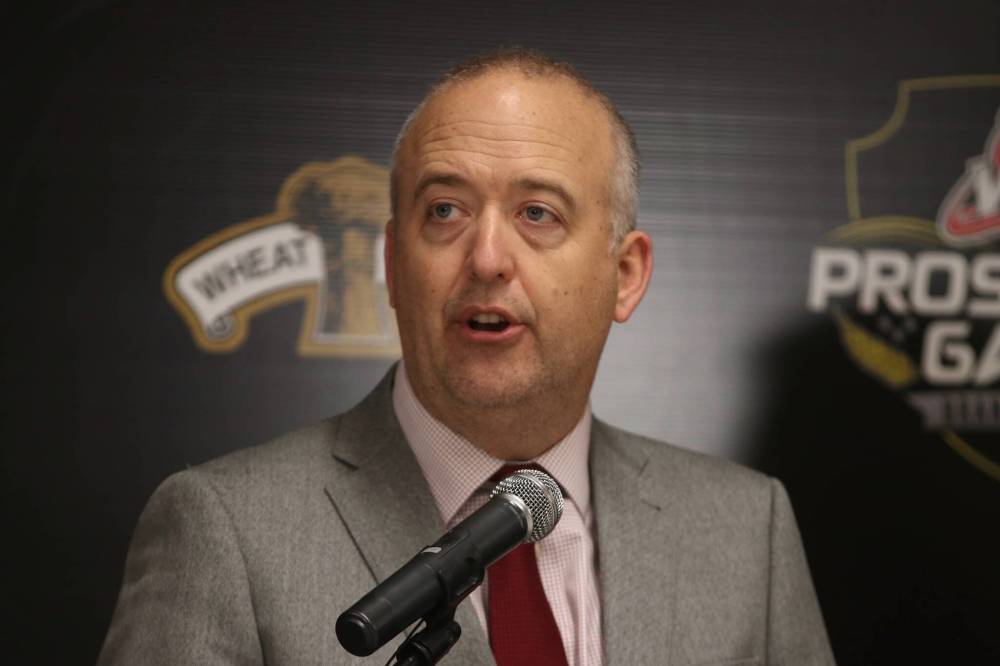
Western Hockey League commissioner Dan Near, shown during a press conference in Brandon in March, said Tuesday during a media availability that the league is tinkering with a number of things in the upcoming season. (Perry Bergson/The Brandon Sun)
The 68-game, regular-season schedule for each team will be extended by one week, cutting out a couple more midweek games, and in Brandon’s case, likely allowing it to host the first round of the playoffs without worrying about the Royal Manitoba Winter Fair.
“With these changes, it will eliminate two to three weekday games from our clubs’ schedule, opening time for players to focus on skill development, strength and conditioning, rest and recovery and of course academic endeavours,” Near said. “By all accounts, this will create an immediate improvement to the WHL player experience, based almost entirely on feedback provided to us by the players themselves.”
The season begins Sept. 18, 2026 and finishes up on March 28, 2027.
The other possibility was reducing the number of games. The WHL already dropped from 72 games to 68 in the 2018-19 season, and the QMJHL dropped from 68 games to 64 for the 2024-25 campaign.
“It’s a discussion that comes up every once in a while,” Near said. “… I think one of the things we’re trying to assess right now is that we heard college hockey is trying to play more games. They’re trying to be a little bit more like us in that regard, so the idea of us taking one of the things that we think makes our league unique and distinct and giving that away is something we’re not sure about.”
He said there likely wouldn’t be tremendous costs in losing two home games, because it also cuts two road games and tightens a team’s inventory a bit. He said they’ve had cursory discussions about whether it would be best for player development but it didn’t gain any momentum.
PLAYOFF CHANGE
Two other shoes dropped to make the longer season work.
Firstly, tiebreaker games will no longer be held to determine who advances if there is a tie for the eighth seed in a conference. Secondly, the opening round of the playoffs will go back to five games from seven when they begin on Wednesday, March 31, 2027.
The first-round format will vary based on geography, availability of facilities and the preferences of the higher-seeded clubs. There are four possible configurations for the games.
• 1-2-1-1 (Away-home-away-home).
• 2-3 (A-H) for longer distances.
• 2-2-1 (H-A-H).
• 1-1-1-1-1 (H-A-H-A-H) for close distances.
“This was one that was a contentious matter at the end of the day because we often talk about being NHL-like and wanting to maximize and mirror what the NHL does, and the NHL does seven-game series,” Near said, who noted the AHL also has a five-game opening series format. “We have some flexible scheduling options based on the types of matchups and geography.”
He said it creates a lot of pressure on the higher seeds if they lose the first game, but data suggests the overwhelming majority of first-round series are shorter than six games anyway and usually won by the higher seed.
Just one eighth seed has won an opening-round series in the last decade, and fewer than 10 per cent go to seven games.
TRAVEL
WHL clubs will be permitted to fly for one set of road games, but only for out-of-conference matchups when the bus trip is longer than 10 hours.
“While travelling by bus across the Prairies has oft been regarded as a rite of passage for the Western League experience, there is no question the geographic span of the league creates unique challenges, particularly for out-of-conference road games,” Near said. “By permitting clubs to travel by air for one out-of-conference road trip per season, this addresses key feedback provided to the WHL directly by the players in a player survey we hosted designed to improve the WHL player experience.”
The policy begins this season, but Near added it may not be used by everybody initially as the league figures out how they can make it work better through scheduling.
“It will be strongly encouraged,” Near said. “I think you can imagine when some teams are doing it that players on other teams will certainly want or expect to have that privilege as well. I expect it to be the norm but I can’t say that with certainty that every trip inter-conference this year will be air travel because that might not be the reality as we get this thing out of the gate.”
It’s something the WHL board has discussed before, but concerns over the expense and the availability of airports in every market held it back.
Near said the cost of doing business is going up, and that includes everything from meals to bus travel to the cost of extra drivers.
“When you actually start to do the math, if you book these trips in advance commercially — we won’t charter — the economics aren’t nearly as difficult as maybe we once thought they were,” Near said.
He said being able to buy tickets months in advance is a real benefit, although teams will have to still figure if sending the bus out with the equipment is more cost effective.
The airport issue is a bit more vexing, but Near said that may just require some scheduling wizardry.
He used Swift Current as an example.
“Should they be playing the first or last game of their trip in Calgary or Regina?” Near asked. “It would change how we do our scheduling to allow for it to be optimized.”
It also potentially opens up the possibility of each team playing a home-and-home series with the clubs from the other conference.
“It’s not currently on the docket, but as we evaluate year by year how some of these changes go and what we think is important, we’l make decisions and introduce those conversations as we go, but it’s not an active topic,” he said.
Near added it’s the issue mentioned most to him by players since he started the job on Feb. 15, 2024.
INTER-LEAGUE
If Brandon is flying to Victoria, wouldn’t it be just as easy to fly to Ottawa to meet the Ontario Hockey League’s 67s or to Halifax to meet the Quebec Maritime Junior Hockey League’s Mooseheads?
Near admits it’s an intriguing idea.
“We think that is something that could be interesting and exciting for fans to take on,” Near said. “Again, how you reconcile it, how you make it work in the schedule … For example, we talked about teams coming to us one year and we go back the next year. If we were to do that, it results in having increased number of home games one year and a reduced number the following year.
“It sounds simple, but when you talk about season ticket packages and operations and logistics, I’m not so much worried about playoff qualification, but those are the things you have to iron out.”
The OHL’s London Knights are flying out to Victoria to meet the Royals in the pre-season.
OVERTIME
The WHL is borrowing a concept from a European league in an attempt to make three-on-three overtimes a little more dynamic, something they call “no-return overtime.”
In a pre-season pilot project, players will be prohibited from circling back over the offensive blue-line into the neutral zone if they don’t like what they see. If they do come back over the blue-line and the other team doesn’t immediately gain possession of the puck, the play will be whistled down and a faceoff will be held in the offending team’s zone with no line change permitted.
“What we’re concerned about is repeated, deliberate exits and really slowing down the game and demotivating a team around active scoring chances,” Near said.
After the pre-season ends, the number of shot attempts and scoring chances and the percentage of games without a shootout will be assessed, with WHL general managers then voting whether to retain the rule.
Near said the GMs will meet between the end of the pre-season and the start of the regular season to determine if they will proceed as tested, go forward with modifications or turn it down entirely.
GIANT MOVE
The Vancouver Giants announced Tuesday they’ll be moving from the 5,276-seat Langley Event Centre to a new 10,000-seat arena being constructed in Surrey in the 2030-31 season.
The team originally played in Vancouver at the Pacific Coliseum in 2001 but left for Langley in 2016. The new development, which will also include a hotel and conference space, is projected to cost $360 million and is expected to be finished in 2030.
“I haven’t seen too much about the new building and I’m not overly familiar with the project,” Near said. “We’re excited for the Giants. You can imagine getting into a new building and the player amenities and the environment and the ecosystem around it, from restaurants and hotels … I think it will take a little bit of time to understand this project better.”
Near has heard there will be better access to public transportation in Surrey, which will be a bonus for fans.
CHILLIWACK
The team was originally scheduled to begin play in the 2026-27 season, but things haven’t quite worked out as planned and that was moved back a year.
The league was in exclusive negotiation with one bidder in Chilliwack who was selected as a franchisee, but negotiations with the City of Chilliwack for a rink lease stalled. The city is putting $4 million in improvements into the building, and since a 10-year lease was being sought, it’s not an easy deal to reach.
“As such, the WHL has invited an additional interested party to participate in the process and assess the opportunity for WHL in Chilliwack,” Near said. “The group has met with the city, with a variety of stakeholders in the market and submitted a highly competitive bid, which is currently being considered by the WHL board of governors.”
The league’s hope is the team will begin play in the fall of 2027, but that remains up in the air as the two potential franchisees try to make a deal.
If Chilliwack comes on board, it will mean the Western Conference will have 13 teams, with six in the U.S. Division and seven in the B.C. Division. The Eastern Conference, which once had the majority of the teams, has five Alberta teams in the Central Division and six in the East Division in Manitoba and Saskatchewan.
Near was asked if the imbalance would be addressed, potentially by bringing aboard a couple of new Alberta teams.
“Those are some of the issues that keep us up at night,” Near said. “We want to make sure we have it right. The league has a history of imbalance and some of the ramifications — the ones that stand out the most — are playoff qualification. If you have eight on each side, that means three on one side and five on the other side don’t qualify.”
U.S. EXPANSION
The NAHL has welcomed five new teams from Colorado, Utah, Idaho and Montana, which is outside the WHL’s footprint but is in an area that has become fertile recruiting ground for major junior teams.
In addition, the USHL is putting teams in Arizona, California and Nevada.
“We’re aware of it and we’ve been monitoring those announcements,” Near said. Near, who was limited about what he could say by nondisclosure agreements, said the best players in the world still want to come to major junior, adding it wouldn’t be easy to build a league that would rival them.
He also said the WHL wasn’t going to be drawn into a turf war.
“We’re not going to rush,” Near said. “We’re going to be moderate and we also want to be mindful of having the right number of clubs for the available number of players at this level of hockey.”
ATTENDANCE
More than 3.2 million fans attended regular season WHL games last season, an average of 4,144 per game and four per cent increase from the 2024-25 campaign.
Near said it’s the highest attendance for a junior hockey league in the world.
NHL DRAFT
The WHL had 37 current players and two alumni selected, the league’s best showing since 43 were taken in 2010. Near noted 24 of the top 100 picks were developed in the WHL, more than any other league.
He said that’s a combination of development work by the provincial hockey bodies, the Canadian Sport School Hockey League and the WHL.
Last season, there were eight NHL captains from the WHL and 144 former WHLers on opening-night NHL rosters.
PROSPECTS
Near said hundreds of NHL scouts representing all 32 teams were in the building for the inaugural WHL Prospects Game on Feb. 18 at the Langley Events Centre.
Brandon hosts the game next season on Feb. 17, 2027. Wheat Kings season ticket holders receive priority access to tickets, with the date of public sale to be announced at a later date.
ONLOOKERS
The WHL showed its games free on Victory+, with a 63 per cent jump in average viewership in the playoffs after viewership more than doubled during the season.
PENTICTON
The Penticton Vees joined the WHL last season as an expansion club and were strong out of the gate, winning the B.C. Division, and falling in the Western Conference semifinals to the eventual champion Everett Silvertips.
“What a fantastic story that had all the ingredients for success,” Near said. “An enthusiastic fanbase, a fantastic hockey club, a supportive community and strong management.”
Head coach and general manager Fred Harbinson was named executive of the year.
SCHOLARSHIPS
The program hit its 33rd year, with 370 WHL graduates drawing on the money, which last season was close to $3 million.
Although the WHL office administers it, the scholarships are funded by the teams. For every season played in the WHL, players receive a scholarship that covers tuition, textbooks and compulsory fees to a post-secondary institution of their choice.
Near said if all the WHL players expect to go to college instead, there could be a conversation about whether it’s good use of the money.
“If it make our scholarships redundant, I think that brings up questions on is there a better way we can use that $3 million investment than we do before, keeping in mind our players are amateur athletes and so the idea of creating payroll, so to speak, is not something that would be on the table for us for a variety of reasons linked to amateurism,” Near said.
DRAFT DAY
The OHL and QMJHL both hold their drafts in venues that allow players and their families to attend and meet the staff of the team that takes them, similar to the NHL.
Those two leagues both pick after the Memorial Cup is over, while the WHL selects players in early May.
“It’s on my mind,” Near said. “Last year I watched Quebec — this was Ontario’s first year doing it — but I watched both of them this year and I’ve got to admit, I was envious. I think that moment of the player and his family celebrating being drafted to a junior hockey league is a pretty special moment and one that not all of them will get, most of them will not get in the National Hockey League.”
Part of the issue is making parents travel to one location from the vast expanse of Western Canada and the western United States, and another is how hard it would be on youngsters who attend and don’t get picked.
“I’m softening on that, to be honest with you,” Near said. “I thought the other two leagues did a great job and there are a tremendous number of families who would want to be there or who would want to experience that moment.”
It’s not something that’s been discussed much around the WHL board table yet.
COLLEGE HOCKEY
The greatest amount of time in the press conference was devoted to American schools poaching WHL players, which has become something of an existential threat to the CHL in the minds of many onlookers.
Last week, young star Landon DuPont committed to play his NHL draft year at Michigan starting this fall, joining other young stars like Daxon Rudolph of the Prince Albert Raiders, Ryan Lin of the Vancouver Giants and Carson Carels of the Prince George Cougars who are heading south.
Near said the players who have gone to college in the last couple of years have been the pioneers, and that the best route for development is still being determined. He also dismisses the notion the WHL is getting younger, saying fewer 16 year olds were in the league last season than ever before.
“The depth was at 17 and 18,” Near said. “The configuration changes. I think you’re going to see more star players who are 17 and 18. Historically it’s been 19 and sometimes 20 year old who have been our stars.
“It bears some watching, but I can tell you is, just because there are players making the move right now, some of this has to be determined, how much of it is a trend and how much of it is legitimate or bona fide as relates to where you’ll be better suited for development.”
He said 15 players left the WHL for college hockey before they completed their 19-year-old seasons last year, and it’s hard to make the case any of them were better off leaving major junior. Near added it might take three to five years for players to get a better read on what the better path is.
When asked how he would respond to fans who have been shaken by the exodus, he preached patience.
“I think it’s affecting all teams, and what I would tell the fanbase is that our general managers are going to adapt to the situation,” Near said. “Historically, we’ve been a league that’s been highly driven by cycles, and often four-year cycles, and the draft, and we’re starting to see that there’s such a demand to play in our league right now that you’re going to have players coming in at different junctures, players joining our league who aren’t necessarily four- or five-year players.”
» pbergson@brandonsun.com